





Put your puzzle pieces together before the rotten apple takes shape, or everyone will lose together.
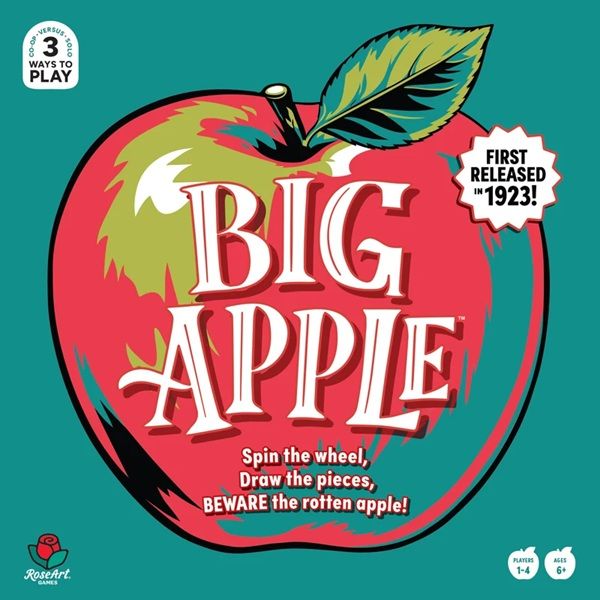
Published by RoseArt Games, Big Apple is for 1-4 players and is a reimagined adaptation of a 1920s game. So has it been updated enough for a modern audience?
Each player is trying to put together a six-piece apple puzzle. The first player to complete his puzzle wins the game. One full set of puzzle pieces for each player, plus one, is added to the bag. The six pieces of the rotten apple puzzle are also added. The spinner is then placed in the center of the table.
On a player’s turn he takes up to three actions. He may choose to use the spinner, spend tokens, or trade. When taking a trade action, he can offer to swap one of his extra duplicate apple pieces for any extra duplicate piece an opponent may have. If the opponent accepts the trade, this counts as one of the active player’s three actions.
To spend tokens, a player may spend 100 points worth of tokens to pull an apple piece from the bag, 50 to force a player to take a trade action (although he can only force an opponent to trade one of his duplicate pieces), or 25 to swap one of his duplicate pieces out with a random piece from the bag.
When spinning, the spinner can give the player tokens, a puzzle piece from the bag, allow the player to return a rotten apple piece to the bag, do a free swap or forced trade without spending the required tokens, or force the active player to end his turn.
After pulling an apple piece from the bag, if it’s one the player doesn’t have, he adds it into his apple puzzle. Otherwise, he holds it as a duplicate for trades and swaps. If a player draws a rotten apple piece, he adds it to the rotten apple puzzle. If the rotten apple puzzle is completed before a player has won the game, everyone loses.
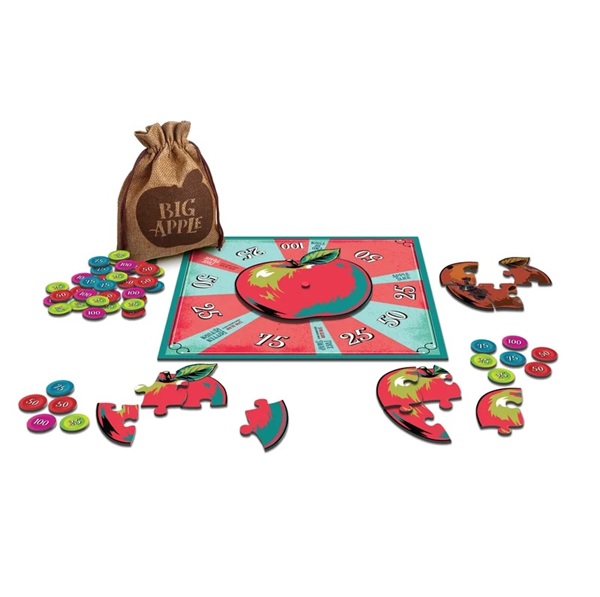
Big Apple looks nice with its apple puzzle pieces, and the mechanic of the rotten apple that can force everyone to lose offers an unpredictable end-game timer. However, despite these positive points, the game falls a little flat.
It’s very luck-based, and while players do have a few choices to make, they feel minimal. There’s a push-your-luck element, as you can choose to spin and save your tokens, but you never feel like you have any real control over the game. You spin, hope to get enough to draw another piece, and if not, potentially consider swapping or trading. The most challenging part is trying to feel the shape of the apple pieces when reaching into the bag, which can be fun, but not enough to carry the game.
All of that being said, this feels like a game that children would enjoy, or potentially groups who enjoy traditional spin-and-move games. It has a great table presence, and even a few additional game modes so that you can play it solo or cooperatively with variants. The fact that trades can only be forced for duplicate pieces also keeps the game from becoming mean, which is good for a younger audience.
Big Apple was not a good fit for our game group. It doesn’t feel like a modern game. Some effort has clearly been put into modernizing it, but it still feels very much from its original time. But it does have a nice production quality, a unique spinner, and enjoyable elements for some families.
Pros: Production quality, fun to see jigsaw pieces in a board game, kids might enjoy it
Cons: Very luck-driven, does not feel like a modern game
Disclosure: we received a complimentary review copy of this game.



The "Buy from Amazon.com" button above is an affiliate link. If you purchase using this link, we may earn a commission.