





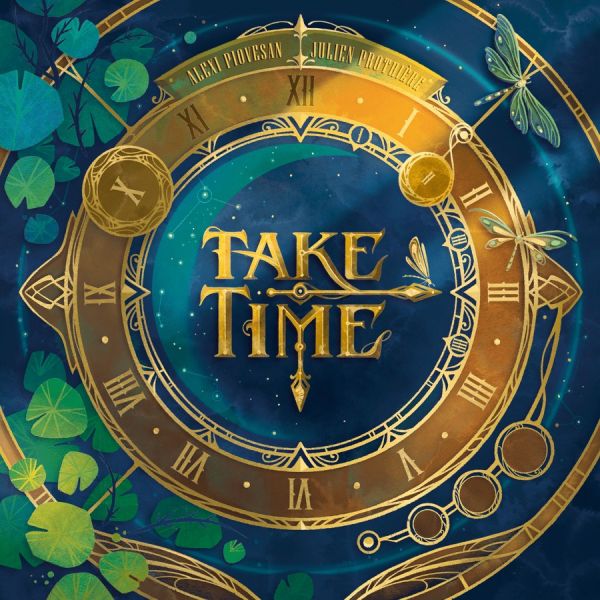
Cooperate to place all of your cards following the rules for each test. The kicker? Once you see your cards, you can no longer talk to each other!
Take Time is a 30-minute game published by Libellud and is designed for 2-4 players. But once you start, you may not be able to stop.
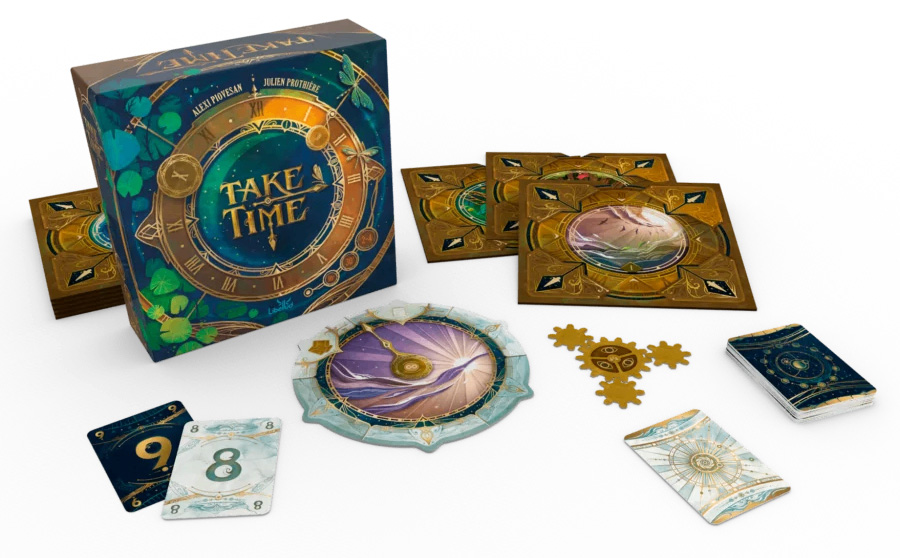
The game contains 40 different tests (challenges) to complete. The tests are divided into 10 different chapters, with 4 tests in each chapter. For each test, a clock card is placed in the center of the table. This card contains 6 segments, as well as requirements for the test.
Players are dealt a certain number of cards. There are solar (white) and lunar (black) decks, each containing 12 cards numbered 1-12. The cards are shuffled together and 12 total cards are dealt out among the players based on player count.
Without looking at their cards, players can discuss openly what their strategy will be to pass the test. However, as soon any player looks at their cards, communication from that player is not allowed (except for certain memory/confirmation questions).
Any player can start by placing a card on any of the segments. Then play proceeds clockwise from that player, with each subsequent player also placing a card on their turn. Cards must be placed face-down, except for a certain number of permitted cards, which may be placed face-up to give information to other players. After all 12 cards have been placed, the round ends and players check to see if they passed the test.
In general, the total value of cards in each segment (starting with clock hand segment and moving clockwise) must be in ascending or equal order. Also, the sum in each segment may not exceed 24. Additional rules also apply and become increasingly difficult for future tests. For instance, some segments require an exact number of solar and lunar cards, and others require the total value within the segment to fall within a certain range.
If players successfully passed the test, they move on to the next challenge. If not, they try again with a bonus token that allows an additional face-up card. If a challenge is too difficult after multiple tries, then can set it aside and come back to it later.
Players win the game if they successfully pass all 40 tests (this will require many gaming sessions to complete). After attempting all 40 tests, they may move on to the special Rebirth sleeve to gain additional replayability.
Take Time is a very fascinating and addicting cooperative puzzle game. It blends the progressive challenge of games like The Crew with the silent mind-reading elements of The Mind. The gameplay itself is quite easy to learn: just place cards around the clock. But figuring out which segments to place your cards in to meet the requirements of each test, without seeing most of the other players’ cards, is a real mind-bender.
The tests and rules for each test were interesting, and they progressed well in difficulty. We found ourselves playing over and over, hoping to try out higher chapters. It felt great when our minds clicked and we succeeded in completing a test. Failing a test didn’t discourage us from trying again, though — it made us want to play even more. And the bonus tokens provide a little boost during your subsequent attempts.
The components in this game are beautiful and well-made. The box is relatively compact, but jam-packed with items. Everything is well-organized with individual chapter sleeves, meaning that you don’t have to fiddle with a lot of components before you can jump in and play.
As a silent cooperative game, Take Time will appeal to certain types of groups but may not shine in others. If your group enjoys solving puzzles silently, relying on each individual player to click into the subtle information given during the round, you will love this game. If your group prefers louder or more interactive games, or there are less experienced players who don’t quite understand the strategy, this is probably a game to skip. For our group, we really enjoyed it and want to keep playing.
Take Time may be a relatively short and simple game at its heart, but once you get started, you’ll take a lot more time than you intended trying to complete as many tests as possible. So, give it a try and get ready to lose track of time. Recommended!
Pros: Engaging cooperative gameplay, progressive difficulty, great visuals and component quality
Cons: Silent cooperation may not click with every group



The "Buy from Amazon.com" button above is an affiliate link. If you purchase using this link, we may earn a commission.